


Relocating your business to the Netherlands or launching a new venture in the country is not only a strategic gateway to the European market but also a major step toward enhancing your company’s global credibility and operational security. For new entrepreneurs and international company owners, navigating the Dutch legal and commercial system can sometimes appear complex. The Netherlands offers a variety of legal entity types, each subject to specific statutory rules and compliance obligations. Selecting an unsuitable structure may expose directors to unnecessary personal liability risks, increase operational costs, or limit future restructuring options.
Each Dutch company structure carries distinct legal, financial, and operational implications that directly impact liability, governance, and long-term growth. This article aims to help founders and business owners understand the advantages and disadvantages of Dutch legal entities, enabling them to identify which structure best supports their objectives under Dutch corporate law.
Overview of Dutch Legal Entity Types
The Dutch legal system distinguishes between entities with legal personality and those without it. This distinction has significant consequences for personal liability, taxation, governance, and long-term scalability. Understanding these differences is essential before registering a business with the Dutch Chamber of Commerce.
Essentially, your choice of entity determines whether your personal assets remain shielded or become inextricably linked to your business risks. For international founders, selecting the right legal form is not just a formality but a strategic move to optimize tax efficiency from day one. Navigating these nuances carefully ensures that your corporate foundation is built for both stability and future expansion.
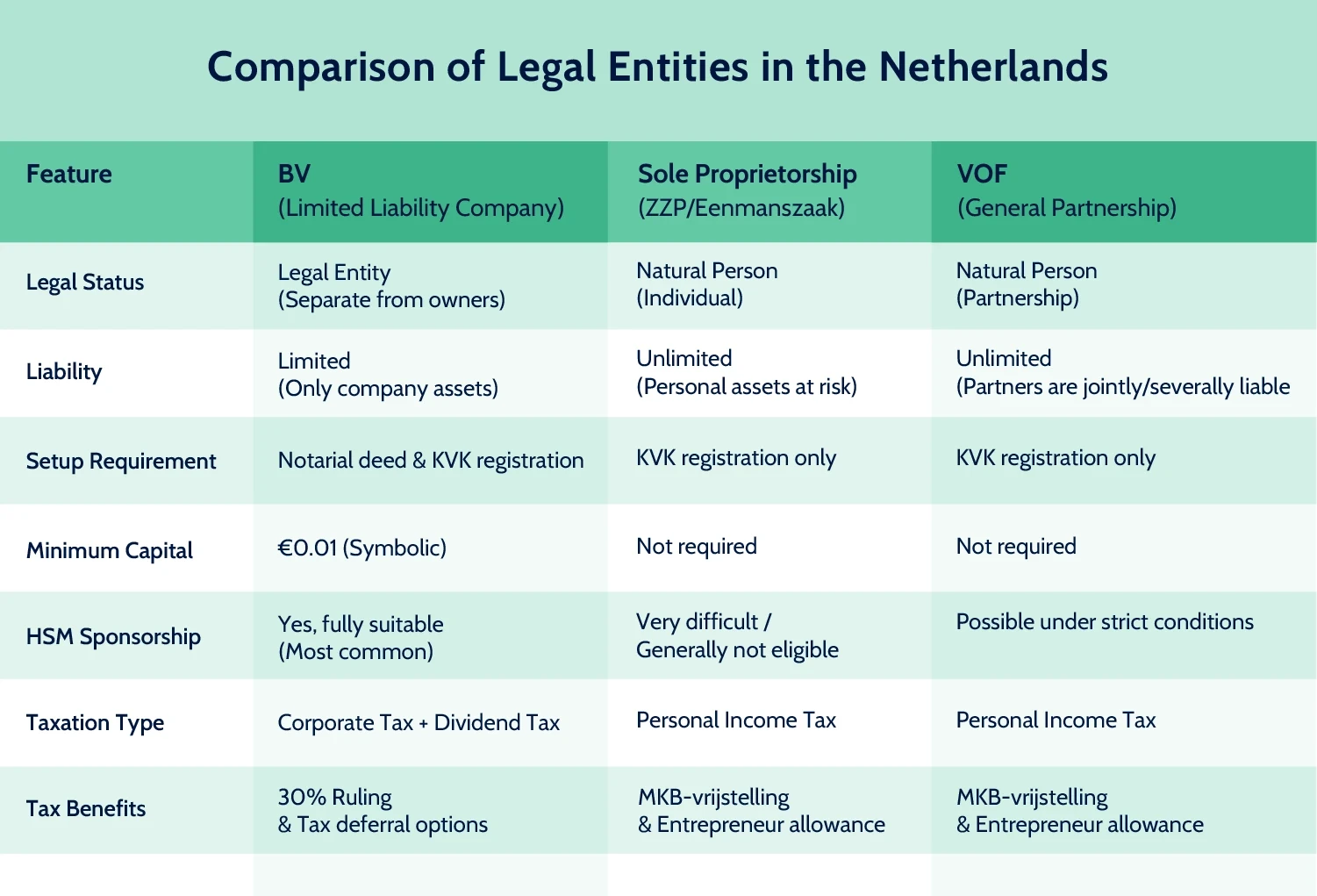
What is Dutch BV?
The Dutch BV is the gold standard for startups, scale-ups, and multinationals operating in the Netherlands. Its sophisticated framework masterfully balances operational agility with rigorous liability protection, cementing its status as the vehicle of choice for sustainable commercial expansion.
Advantages;
Limited liability protection separates personal assets from company obligations
Strong credibility with investors, banks, and commercial partners
High flexibility of articles of association, particularly attractive for startups
Well-suited for holding structure benefits and subsidiary formation
Disadvantages;
Higher incorporation and operational costs compared to unincorporated entities
Mandatory notarial incorporation deed
Ongoing compliance with corporate governance and filing obligations
Although the minimum share capital requirement is symbolic (€0.01), the BV’s legal complexity requires careful planning and professional guidance.
To explore the advantages of starting a business in the Netherlands, you may review our blog post titled "What are the Benefits of Establishing a Company in the Netherlands?
Sole Proprietorship
The sole proprietorship is frequently utilized by freelancers and independent entrepreneurs entering the Dutch market with a focused operational scope. While this structure offers significant administrative simplicity and direct tax transparency, it establishes a singular legal identity where no distinction exists between personal and business assets.
Advantages
Simple and fast Chamber of Commerce registration
Low operational and administrative costs
Full tax transparency
Disadvantages
No legal personality
Full personal liability for debts and legal obligations
Limited suitability for growth, investment, or restructuring
The choice between a Dutch BV and a sole proprietorship often hinges on two critical pillars: the protection of personal assets and the flexibility to scale the business in the future.
Liability and Corporate Governance Considerations
Statutory liability and corporate governance frameworks vary substantially based on the selected legal entity, profoundly impacting the obligations of directors and shareholders alike. The alignment of these structural elements with a company’s risk profile is a fundamental requirement for ensuring long-term regulatory compliance and institutional stability.
Personal Liability and Statutory Director Liability
Under Dutch corporate law, directors of a BV generally benefit from limited liability. However, statutory director liability may arise in cases of mismanagement, failure to meet tax or filing obligations, or improper administration.
In contrast, legal entities without legal personality—such as sole proprietorships and general partnerships—expose founders to joint and several liability, meaning personal assets may be used to satisfy business debts.
Governance Structures and Shareholder Agreements
A Dutch BV allows for structured governance through:
Articles of association
Shareholder agreements
Clearly defined decision-making and voting rights
Robust shareholder agreements and clear dispute resolution frameworks are vital for multi-founder ventures. Under Dutch law, these tools do more than just prevent friction—they provide the institutional stability necessary for seamless, long-term growth.
Partnerships and Tax Transparency
Partnership-based structures are frequently adopted for collaborative or professional ventures, particularly when fiscal transparency and tax efficiency remain paramount objectives. However, while these entities facilitate a direct flow-through of profits, they necessitate a meticulous contractual framework to mitigate the inherent risks of shared legal liability.

Dutch General Partnership (VOF)
A Dutch general partnership offers tax transparency, meaning profits are taxed at the partner level rather than at the entity level.
Advantages
Flexible structure
No minimum share capital requirements
Suitable for professional collaborations
Disadvantages
Partners are jointly and severally liable
Limited appeal for external investors
While tax transparency benefits can be attractive, partnerships require robust internal agreements to manage legal and financial risk.
Strategic Structuring for Growth and Tax Efficiency
Beyond simply choosing a legal form, strategic structuring is a cornerstone of long-term business success. It allows founders to anticipate future milestones, ensuring the company remains agile as it scales. By aligning your legal setup with your growth roadmap, you turn a compliance requirement into a competitive advantage.
Holding Structures and Subsidiary Formation
Setting up a holding company structure to minimize tax exposure is a common strategy in the Netherlands. A holding BV can own one or more operating subsidiaries, enabling:
Dividend and capital gains efficiencies
Risk segregation between activities
Simplified exit or restructuring scenarios
Holding structures are particularly relevant for startups planning fundraising or international expansion.
Converting or Restructuring Existing Entities
Entrepreneurs entering the Dutch market may also consider converting a foreign legal entity into a Dutch company structure or establishing a local subsidiary. This process requires careful legal and tax analysis, particularly regarding UBO register compliance, contractual continuity, and governance alignment.
Registration, Compliance, and Ongoing Obligations
Regardless of the structure you choose, maintaining a Dutch legal entity involves a continuous commitment to formal registration and reporting standards. Compliance isn’t a one-time task; it’s a lifecycle obligation that demands proactive management to avoid administrative pitfalls. Keeping your records current with the KVK and tax authorities is fundamental to preserving your company's standing in the Netherlands.
Chamber of Commerce Registration and UBO Compliance
Businesses must meet statutory requirements for registering a business at the KVK, including:
Registration with the Dutch Chamber of Commerce
UBO register compliance
Maintaining a legally valid registered office
Failure to meet these obligations may result in penalties or director liability.
Annual Filings and Liquidation Procedures
Entities with legal personality must comply with Dutch Chamber of Commerce annual filing regulations, including:
Annual accounts submission
Reporting corporate changes
Following formal liquidation procedures when dissolving a company
Understanding the legal process of liquidating a Dutch company structure is just as important as proper incorporation.
Strategic Considerations for Dutch Company Structures
When selecting or restructuring a Dutch legal entity, founders and executive stakeholders must evaluate several critical determinants to ensure alignment with their strategic roadmap. Prudent consideration of these factors at the inception stage is vital for mitigating future legal exposure and optimizing the group’s operational scalability.
Evaluate personal and statutory director liability risks
Compare operational costs across legal structures
Review the minimum share capital and notarial requirements
Structure governance through articles of association and shareholder agreements
Ensure correct Chamber of Commerce and UBO registration
Assess holding structure benefits for tax and risk management
Seek legal guidance before restructuring or liquidation
The Netherlands offers a market full of diverse opportunities for entrepreneurs looking to establish a new business or expand their existing operations. By gaining deeper insights into the Dutch market, you can take firm and confident steps forward.
Navigating the Dutch Business Landscape and Legal Framework
The Netherlands offers a flexible and business-friendly legal environment, but each legal entity comes with distinct advantages and limitations. Understanding liability exposure, governance requirements, tax transparency, and ongoing compliance obligations is essential for building a sustainable company structure. With the right legal setup, entrepreneurs can protect their interests, control operational costs, and support long-term growth. At Unusual Companies, we guide new entrepreneurs and company owners through the Dutch legal landscape, providing clarity and support as they grow their businesses in the Netherlands.


